Commercial tenant improvements insurance in California: who actually owns what
If you lease commercial space in Fresno, Clovis, or anywhere else in California's Central Valley, you have probably put real money into making that space work for your business. New flooring, custom lighting, a built-out server room, a redesigned storefront. That investment is called a tenant improvement , and the question of who is responsible for insuring it is one of the most misunderstood areas of commercial insurance. The short answer: it depends on your lease, and if you assume your landlord has it covered, you could be wrong in a very expensive way.
What tenant improvements actually are
Tenant improvements (TIs) are permanent alterations or additions a tenant makes to a leased space. They become physically attached to the building. California courts generally treat them as real property once installed, which means they are not automatically covered by a standard commercial property or business owner's policy the same way your equipment or inventory would be.
Common examples include:
- Partitions and walls , including framed rooms, glass dividers, or cubicle structures built into the floor plan
- Electrical and plumbing upgrades , such as dedicated circuits for medical or restaurant equipment and upgraded restrooms
- HVAC modifications , including ductwork added to serve a new layout
- Flooring , such as polished concrete, tile, or hardwood installed over the building's original slab
- Signage and storefronts , including custom exteriors, roll-up doors, or window displays built into the structure
The dollar amounts add up fast. A small restaurant buildout in Fresno can run $80 to $150 per square foot or more. A 1,500-square-foot suite with custom improvements could represent $120,000 to $225,000 in exposed value that nobody is insuring unless someone specifically chose to.
How California leases split insurance responsibility
California does not have a single statewide law that assigns TI insurance responsibility to the landlord or the tenant. It is almost entirely governed by your lease agreement. This is where business owners run into trouble: they sign a standard commercial lease without reading the insurance section carefully, and they assume the building owner's property policy picks up any permanent fixtures.
In reality, most commercial leases in California follow one of three structures:
- Landlord insures base building, tenant insures TIs. This is the most common arrangement in full-service or gross leases. The building owner covers the shell and base systems; you cover everything your business installed.
- Landlord insures everything, including TIs. This is less common, usually found in larger institutional properties where the landlord paid for and controls all improvements. You will see this documented explicitly in the lease.
- Triple-net (NNN) leases. Common in Fresno-area retail and industrial properties, these leases often place a broader insurance obligation on the tenant, sometimes including the building shell itself, not just the improvements. Read these leases carefully.
Before signing any commercial lease, have your insurance agent review the insurance obligations section. Not all agents do this proactively, but a good independent agent will ask for the relevant lease language and tell you exactly what coverage you need to satisfy it.
What commercial tenant improvements insurance actually covers
A commercial tenant improvements and betterments policy (sometimes called "improvements and betterments" or "TI coverage") covers the cost of repairing or rebuilding tenant-installed improvements after a covered loss, such as fire, vandalism, burst pipes, or certain water damage events.
A few points to understand about how the coverage pays out:
Replacement cost vs. actual cash value
This distinction matters. Replacement cost coverage pays what it actually costs to rebuild the improvement to its original condition using current materials and labor. Actual cash value pays replacement cost minus depreciation. A custom flooring installation from eight years ago may have depreciated significantly on paper, meaning an actual cash value settlement leaves you well short of what a rebuild costs. In California's construction market, where labor and material costs have risen sharply, that gap can be substantial. Replacement cost coverage is worth the additional premium.
What triggers coverage
TI policies are typically written on a "named perils" or "special form" basis. Special form (sometimes called "open perils" or "all-risk") is broader and covers losses unless they are specifically excluded. Named perils covers only events listed in the policy. For most California businesses, special form is preferable because it does not leave gaps for unusual causes of loss.
What is typically excluded
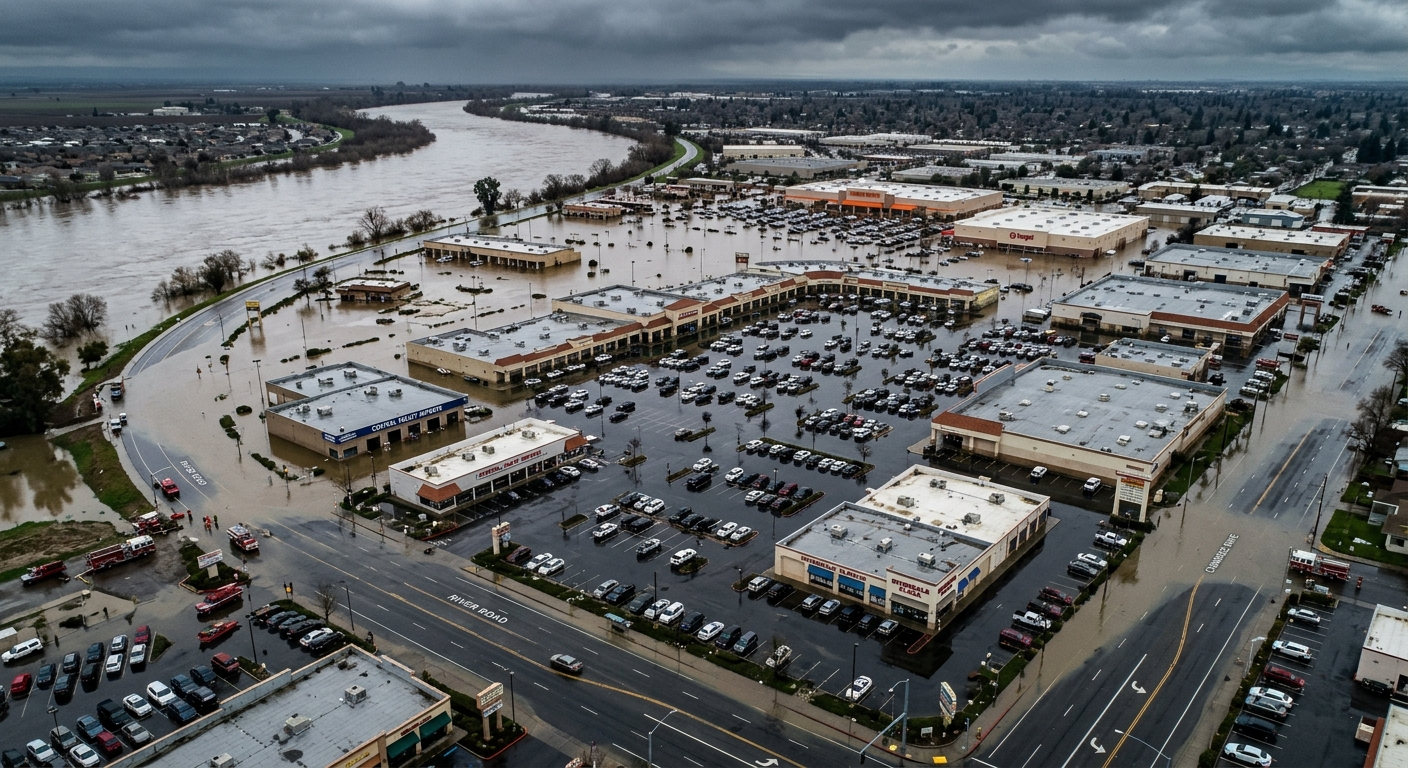
- Flood damage. Standard commercial property policies exclude flood. If your leased space is in a flood-prone area near the San Joaquin River or in any FEMA-designated zone, you need a separate commercial flood policy.
- Earthquake damage. Also excluded from standard property forms in California. Given that the state sits on multiple active fault systems, this exclusion matters. A standalone earthquake endorsement or policy is available separately.
- Intentional acts and wear and tear. Standard exclusions across all property coverages.
The "use it or lose it" problem
One provision that catches California tenants off guard: if a covered loss occurs and you cannot rebuild the improvements before your lease expires, most policies will only pay a proportional value based on the remaining lease term, not the full replacement cost. This is called the "interest" or "proportional value" clause. The fix is to carry enough lease term, have renewal options in place, or negotiate with your carrier for a different valuation method at policy inception.
How TI coverage fits into your broader commercial insurance program
Tenant improvements insurance does not stand alone. It should be part of a coordinated commercial insurance program that covers all the assets your business depends on. Here is how it connects:
Business owner's policy (BOP)
A business owner's policy bundles commercial property and general liability into one package, often at a lower combined cost than buying the coverages separately. For small to mid-sized businesses leasing commercial space, a BOP is often the right foundation. Many BOP forms include a TI coverage sublimit automatically, but that sublimit may be far lower than your actual exposure. Always check the limit and adjust it to reflect your real TI investment.
Commercial property insurance
If your business is too large or too specialized for a BOP, a standalone commercial property policy gives you more flexibility to set TI limits accurately, choose valuation methods, and tailor coverage for specific risks. Understanding what commercial property insurance covers in detail helps you identify where TI coverage fills gaps that a standard property form leaves open.
Business interruption coverage
A fire that destroys your tenant improvements does not just create a rebuilding cost. It shuts down your revenue. Business interruption insurance covers lost income and ongoing expenses while your space is being rebuilt. Without it, you pay rent on a space you cannot use and cover payroll on a business that is not generating revenue. This coverage should be coordinated with your TI limits because the longer the rebuild, the more income you lose.
General liability
Tenant improvements can create slip-and-fall hazards during construction or after installation. A general liability policy protects you if a customer or visitor is injured because of a condition related to your buildout. This is separate from TI property coverage but equally important to have in place before a contractor begins work.
Practical steps for California tenants before and after signing a lease
Getting TI coverage right requires doing a few things in the right order:
- Read the insurance section of your lease before you sign. Look for language about who insures improvements and betterments, what the minimum coverage requirements are, and whether the landlord's insurer has waived subrogation against you (a standard and important clause).
- Document your TI investment thoroughly. Keep contracts, receipts, and change orders for every improvement. Photos before and after buildout are also useful. This documentation is what your insurer uses to establish value at claim time.
- Set coverage limits based on actual replacement cost. Not what you paid, not what you think it is worth, but what a contractor would charge today to rebuild from scratch. In California's current construction market, that number is often higher than business owners expect.
- Review limits annually. Construction costs in the Central Valley, like most of California, have increased significantly over the past several years. A limit that was adequate when you first moved in may be 20 to 30 percent too low a few years later.
- Check whether your landlord requires you to be named on each other's policies. Many California commercial leases require tenants to name the landlord as an additional insured on their liability policy, and some require mutual waivers of subrogation on property policies. These are easy to add but must be explicitly requested.
- Coordinate with your contractor's insurance during buildout. While improvements are being constructed, completed work may fall in a coverage gap between your tenant improvements policy (which typically covers completed work) and the contractor's builder's risk or installation policy (which covers work in progress). Clarify who covers what before construction begins.
A real scenario: what happens without the right coverage
Consider a medical office in Fresno that leased a 2,000-square-foot suite and invested $180,000 in a custom buildout: exam rooms, specialized plumbing, medical-grade flooring, a dedicated electrical panel, and custom millwork at the front desk. The tenant carried a BOP with a $50,000 TI sublimit, which seemed reasonable when the policy was first written two years earlier.
A fire in an adjacent suite spreads and causes significant smoke and water damage. The TI rebuild is estimated at $195,000 after accounting for current labor rates. The insurer pays $50,000. The remaining $145,000 comes out of pocket. The business interruption coverage, also undervalued, does not stretch far enough to cover six months of lost revenue during the rebuild.
This is not a rare situation. It is what happens when TI limits are set by guessing rather than by calculating actual replacement cost, and when policies are not reviewed as businesses grow and investments increase.
Talk to McCarty Insurance Agency about getting this right
If you lease commercial space in Fresno, Clovis, or the surrounding area and you have put money into improvements, it is worth a conversation to make sure those improvements are actually covered and at the right amount. McCarty Insurance Agency is an independent agency, which means we work with multiple carriers to find the right combination of coverage and price for your business rather than steering you toward one company's product.
We can review your lease's insurance requirements, help you calculate an accurate TI replacement cost value, and make sure your overall commercial insurance program fits together without gaps. Learn more about our commercial tenant improvements coverage or reach out directly to start the conversation.
Call us at (559) 324-1421 or contact McCarty Insurance Agency online to get a review of your current coverage. A few minutes of conversation now can prevent a very expensive surprise later.